JFFS V2N4:3 means Volume 2, Number 4, page 3; a range such as V3N6:1–4 covers those pages. The index covers the 14 surviving newsletters only. For unnumbered opening pages, references follow the reviewed scan sequence. Original spellings, contemporary proposals and cross-references are preserved; reported projects are not confirmation of completed films.
#
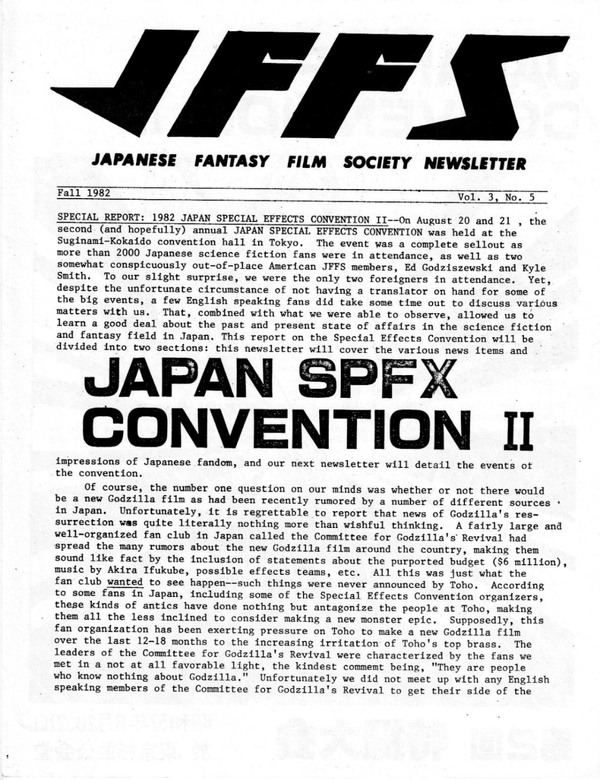
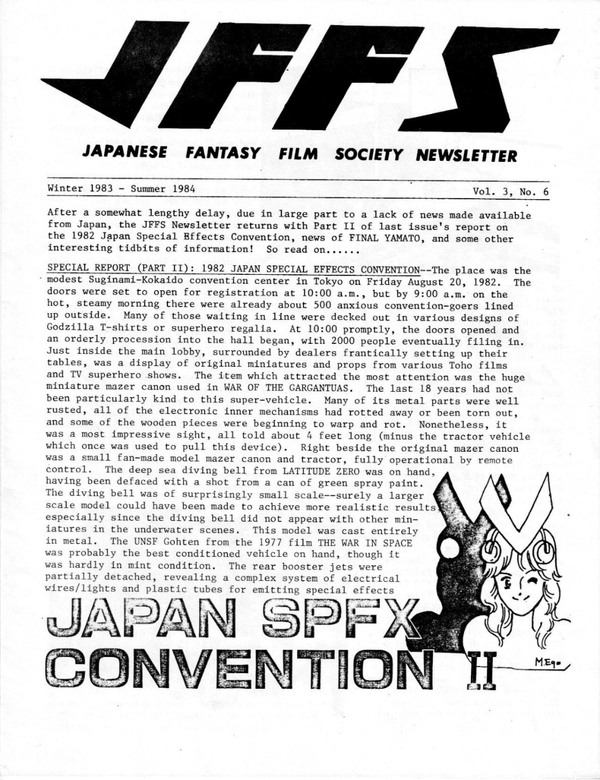
1982 Japan Special Effects Convention — Japanese special-effects convention (1982): Plans to send JFFS representatives to August event in Tokyo — JFFS V3N3:5; Tokyo special-effects convention (1982): JFFS announced planned representative attendance — JFFS V3N3:5; Japan Special Effects Convention II (1982): August 20–21 Tokyo convention; overview and dealer room — JFFS V3N5:1–5; Japan Special Effects Convention II poster: Full-page promotional print with winged woman and monster, signed YK — JFFS V3N5:2; See Japan SPFX Convention II — JFFS V3N6:1–4; Artwork: convention cartoons: Small character sketches and cartoons within convention report — JFFS V3N6:3; Artwork: convention masthead: Stylized female figure; illustrator unidentified — JFFS V3N6:1; Convention miniature photography: Black-and-white photographs of vehicles, props and models — JFFS V3N6:2; Convention video program: Dragonslayer, Ultra 7 and Star Trek II screenings — JFFS V3N6:3; Convention, Japan Special Effects (1982): Opening-day attendance, costumes, program and exhibitions — JFFS V3N6:1–4; Japan SPFX Convention II: 1982 Tokyo event, August 20–21; see convention — JFFS V3N6:1–4.
3-D film production — Steve Miner proposed American Godzilla and technical challenges — JFFS V3N6:4–5.
3-Dians — Japanese makers of detailed fantasy / SF models; Uchusen coverage — JFFS V3N5:4–5.
A
A Girl at Dojo Temple — historical film discussed, JFFS V1N1:3.
Ace Killer — Ace-Killer: Andro Melos report on Ultraman Ace’s captor — JFFS V3N1:1–2; Adversary referenced in Andros Melos origin story — JFFS V3N3:4–5.
Adieu Galaxy Express 999 — August release notice and plot outline — JFFS V3N1:4.
Adventures of Sinbad — animated series mentioned in Toei fairy-tale film comparison — JFFS V2N8:1.
Ageha — Yamato III finale; Phantom escape and sacrifice — JFFS V3N1:2–4.
Akeki, Masayuki — Cyborg 009: Legend of Super Galaxy, director named in news report — JFFS V2N5:3.
Aladdin and the Magic Lamp — 1982 theatrical release and reproduced promotional illustration — JFFS V3N4:4–5.
Albator (Capt. Harlock) — French television broadcasts reported by Jeanette Eilke — JFFS V2N8:4.
Alien Baltaan — Ultraman ’80 — JFFS V2N5:3; Baltaan: returning character in Ultraman ’80; source spelling — JFFS V2N8:2; Baltaan, Alien: Adversary of Andros Melos; android form — JFFS V3N4:4.
Along with Ghosts — film discussed, JFFS V1N1:3.
Alpha Centauri — Garuman–Bollar conflict in Yamato III synopsis — JFFS V2N6:2.
Ambush — Samurai film paired with Magnitude 7.9 at Chicago screening — JFFS V3N5:6.
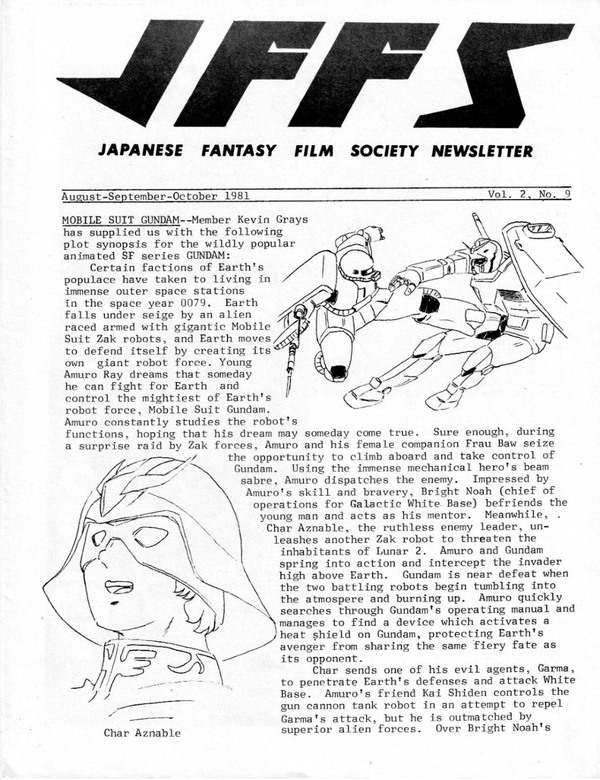
Amuro Ray — Mobile Suit Gundam synopsis supplied by Kevin Grays — JFFS V2N9:1–2.
Anderson, Gerry — Thunderbirds; animated Japanese adaptation — JFFS V3N4:5.
Andros Melos — Andro Melos: Tsuburaya Productions new hero notice — JFFS V3N1:1–2; Tsuburaya hero; television run, older Ultra monsters, costume, production critique — JFFS V3N3:4–5; Andros Melos illustration: Large illustrated figure with Tsuburaya / Ultraman heading; artist uncredited — JFFS V3N3:5; Tsuburaya hero; Carl Young’s television report — JFFS V3N4:4.
Andros Wolf — Silver-and-red partner with blade-like shoulder weapons — JFFS V3N3:5; Character in Andros Melos account — JFFS V3N4:4.
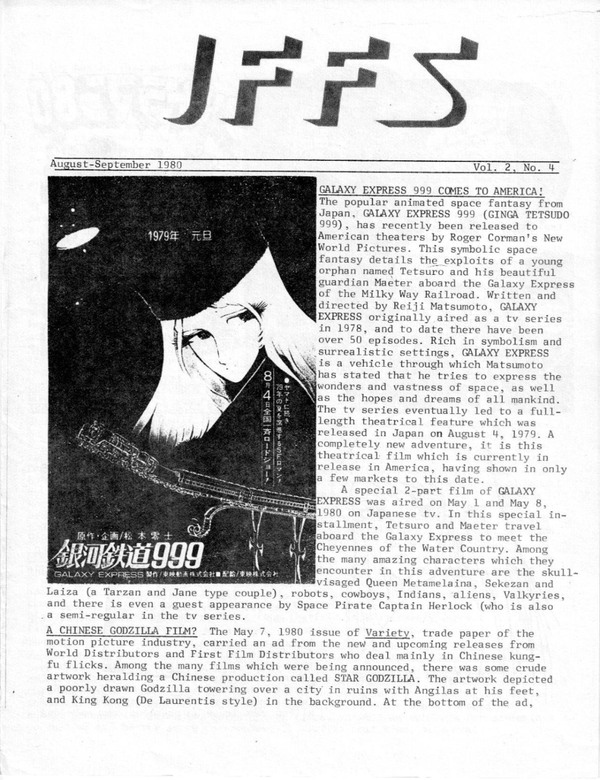
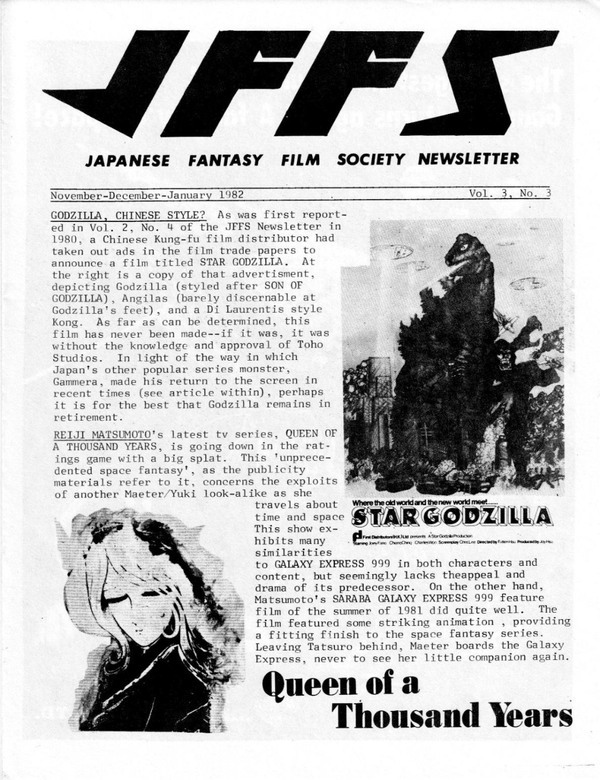
Angilas — anatomical diagram, JFFS Supplement 2 — JFFS V2N6:4; origin, height and weight specifications as printed — JFFS V2N6:4; Monster pictured in unmade Star Godzilla trade advertisement — JFFS V3N3:1; Depicted in reported Star Godzilla advertisement — JFFS V2N4:1–2.
Animation cels — JFFS / Izumiya Co. offer of unpainted Toei animation cels — JFFS V2N9:5; Merchandise offered at Osaka Toei Animation shop — JFFS V3N5:5.
Animation, Japanese — Anime market versus live-action effects and contemporary merchandise — JFFS V3N5:3, 5–6.
Anju & Jushio-maru — earlier Toei animated film cited alongside Swan Lake — JFFS V2N8:1.
Apparition of the Cat — Late-1981 Japanese television broadcast notice — JFFS V3N3:5.
Aquarius (planet) — Water planet and threat to Earth in Final Yamato synopsis — JFFS V3N6:5–6.
Aquarius (Yamato) — Water planet and projected Earth crisis in Final Voyage synopsis — JFFS V3N5:5.
Aquarius, Queen of — Final Yamato character and illustration — JFFS V3N6:5–6.
Arrevederci Yamato — Chicago screening (spelling as printed) — JFFS V2N5:4.
Art Institute of Chicago — Tezuka / Phoenix 2772 screenings, JFFS V2N1:1.
Astro Boy — see Mighty Atom, JFFS V1N1:4; See Mighty Atom, JFFS V2N1:1.
Atlantis — Gammera origin claimed in JFFS Supplement 4 — JFFS V3N3:6.
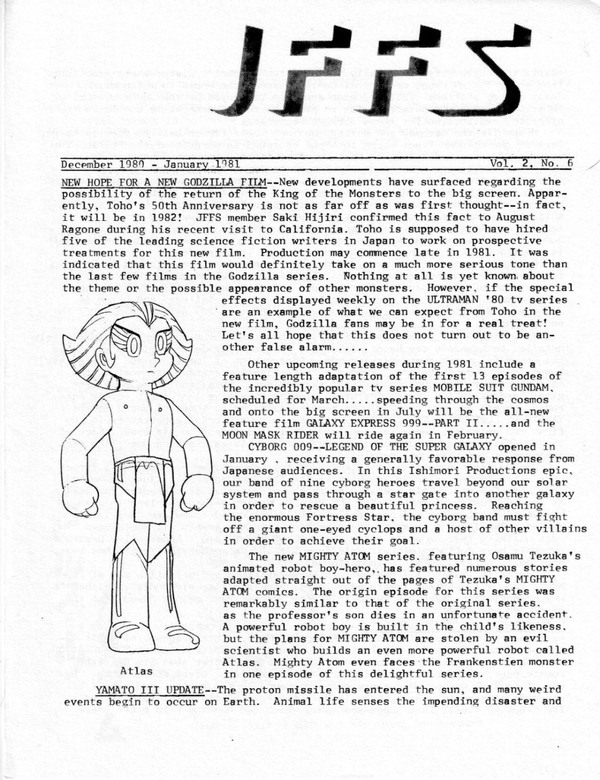
Atlas — robot in Mighty Atom; illustrated character portrait — JFFS V2N6:1; Mighty Atom antagonist in television episodes — JFFS V3N1:4.
Atom-bomb testing — Historical allegory in reprinted Godzilla news article — JFFS V3N4:3.
Atragon — Model of super-submarine for sale at convention — JFFS V3N5:4; Original miniature submarines and convention trailers — JFFS V3N6:2–3; Convention miniatures: Atragon: Two submarine models and large drill component — JFFS V3N6:2.
Atragon, Empress of Mu — Tetsuko Kobayashi in convention finale — JFFS V3N6:3–4.
B
Baldios — Spring 1982 theatrical animation release — JFFS V3N4:4.
Ban — Character in Phoenix 2772 synopsis, JFFS V2N3:3.
Banado — Yamato III battle and Earth-related storyline — JFFS V2N6:2.
Bandai Corporation of America — Possible Star Blazers merchandising agreement — JFFS V3N4:4.
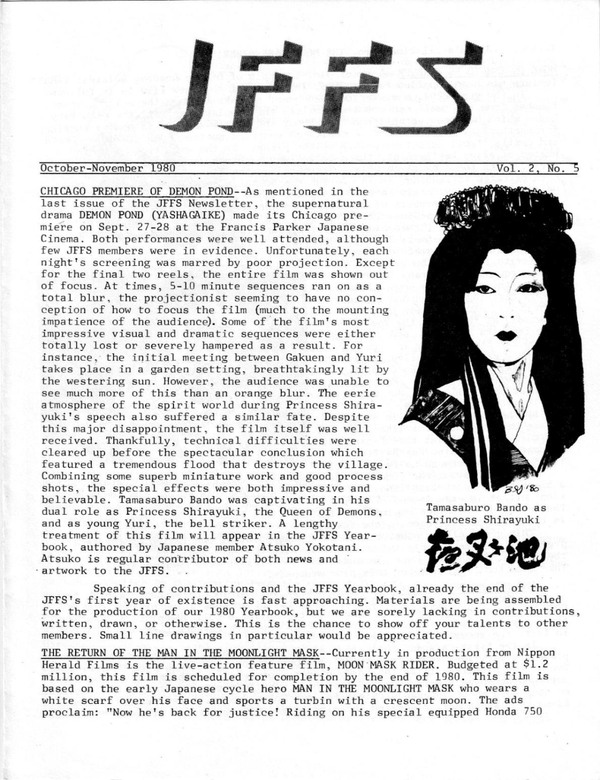
Bando, Tamasaburo — Demon Pond review and Princess Shirayuki illustration — JFFS V2N5:1.
Bando, Tamasaro — Demon Pond star, name as printed in this issue — JFFS V2N4:3.
Baragon — Large limited-edition monster model kit — JFFS V3N5:4.
Battle Fever J — Miss America costume in convention stage show — JFFS V3N6:4.
Battle of the Planets — Canadian television coverage — JFFS V2N5:3.
Battle of the Planets Fan Club — contact notice — JFFS V2N5:4.
BBC — reported prospective X-Bomber broadcast — JFFS V2N6:3.
Bemlar — Yamato III opponent; Black Hole Bombs — JFFS V3N1:2–4; Bemlar illustration: Captioned character drawing; artist not established — JFFS V3N1:3.
Black Hole Bombs — Bemlar’s weapons in Yamato III — JFFS V3N1:3.
Black Jack — Character mentioned in Phoenix 2772 report, JFFS V2N1:1.
Black King — Ultra-series monster named in Andros Melos report — JFFS V3N3:5.
Black Star Empire — Yamato Be Forever synopsis — JFFS V2N5:2.
Blackjack — Character in Phoenix 2772 synopsis, JFFS V2N3:3.
Bolgan — Phoenix 2772 character, JFFS V2N3:2.
Bollar — Yamato 3 synopsis — JFFS V2N5:2–3; Yamato III plot and wartime faction — JFFS V2N6:1–2; Yamato III empire and attack upon Sharubart — JFFS V3N1:2–3.
Bollar Empire — conflict with Garuman and Yamato III plot — JFFS V2N8:3–4; Named in Yamato—The Final Voyage teaser account — JFFS V3N5:5.
Books Nippon — Publisher of proposed Starblazers English-language anime comics — JFFS V3N6:6.
Brax — Villain in proposed Ultraman: The Jupiter Effect — JFFS V2N2:3.
Brewer, Steve — Byline of reproduced Arthur Compean toy-collector newspaper feature — JFFS V3N4:4.
Bright Noah — Mobile Suit Gundam synopsis — JFFS V2N9:1–2.
Bryger, Space Cyclone — Robot show named in TV roundup (as printed) — JFFS V3N4:4–5; Space Cyclone Bryger: See Bryger, Space Cyclone (as printed) — JFFS V3N4:4–5.
Buska — Model kit offered by Kaiyodo Hobby Con — JFFS V3N5:4.
C
Candy — animated program listed among French television shows — JFFS V2N8:4.
Captain Albator — Space Corsair, Canadian television — JFFS V2N5:3; See also Herlock, Captain.
Captain Albator, Space Corsair — French-Canadian title of Space Pirate–Captain Herlock, JFFS V2N3:4.
Captain Flam — French-language Captain Future reportedly broadcast in Canada — JFFS V2N8:4.
Captain Franken — correction to earlier Yamato III captain identification — JFFS V2N8:2.
Captain Future — German and Canadian television broadcast report — JFFS V2N8:4.
Captain Harlock — Space Pirate Captain Harlock, Canadian television — JFFS V2N5:3; Expected appearance in Adieu Galaxy Express 999 — JFFS V3N1:4; My Youth in Arcadia theatrical feature and family backstory — JFFS V3N5:5–6; See also Herlock, Captain, Captain Albator.
Carmody, Don — Don Carmody: Proposed American Godzilla co-producer — JFFS V3N6:5.
Catastrophe: 1999 — American television retitling as The Last Days of Planet Earth; version and censorship discussion — JFFS V2N9:2–3; The Last Days of Planet Earth: American broadcast title of Catastrophe: 1999; edited footage — JFFS V2N9:2–3; American television presentation mentioned in Super Monster review — JFFS V3N3:3.
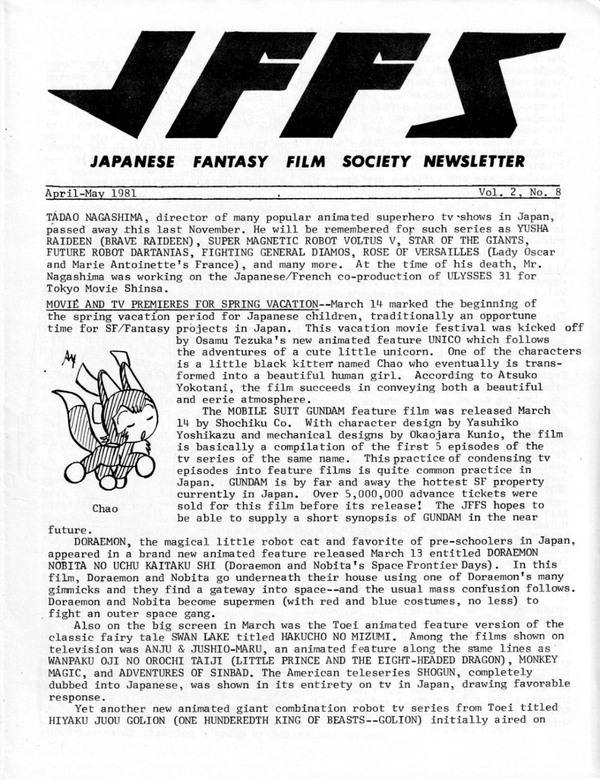
Chao — Unico kitten and illustration signed AY — JFFS V2N8:1.
Char Aznable — Mobile Suit Gundam character in synopsis and illustrated portrait — JFFS V2N9:1–2; Char Aznable portrait: portrait illustration beside Gundam synopsis; unidentified artist — JFFS V2N9:1.
Chicago — proposed JFFS summer mini-convention — JFFS V2N6:3.
Chicago film screenings — Arrevederci Yamato and The Mysterians — JFFS V2N5:4; Demon Pond — JFFS V2N5:1.
Chicago Japanese Cinema — See Francis Parker Japanese Cinema screening announcement — JFFS V3N5:6.
Chikyu E... (Toward the Terra) — Upcoming animated feature — JFFS V2N2:3.
Ching, Chang — Performer named in reported Star Godzilla advertisement — JFFS V2N4:2.
Cinefantastique — Report on preliminary Steve Miner Godzilla project — JFFS V3N6:4.
Clack — Phoenix 2772 character; signed illustration, JFFS V2N3:3.
Close Encounters — Mentioned in Tezuka’s Chicago remarks, JFFS V2N3:1.
Cobra, Space Adventure — See Space Adventure Cobra — JFFS V3N5:5–6; Space Adventure Cobra: New television series and animation shop merchandise — JFFS V3N5:5–6; Space Adventure Cobra: Proposed English screenplay translation — JFFS V3N6:6.
Columbia College, Chicago — First JFFS monthly meeting, JFFS V2N1:1; JFFS screening venue — JFFS V2N5:4; Suspended JFFS monthly screenings with plans to resume — JFFS V2N4:3.
Combattler V — Giant-robot animation reference, JFFS V2N3:4.
Coming Attractions — Report on preliminary Steve Miner Godzilla project — JFFS V3N6:4.
Committee for Godzilla’s Revival — Japanese fans’ lobbying and opposition at convention — JFFS V3N5:1, 3.
Compean, Arthur — JFFS member and collector; newspaper profile — JFFS V3N4:4.
Corman, Roger — New World Pictures U.S. release of Galaxy Express 999 — JFFS V2N4:1.
Cosmo Productions — X-Bomber producer named in television report — JFFS V2N6:2.
Cosmo Tiger — Proposed die-cast model among JFFS merchandise, JFFS V2N1:2.
Craig, Scott — Fictional astronaut in proposed Ultraman: The Jupiter Effect — JFFS V2N2:3.
Crater Lake — Proposed Ultraman--Hero from the Stars battle site — JFFS V3N1:1.
Cyborg 009 — animated television series discussed, JFFS V1N1:4; Japanese television rerun notice and reproduced promotional graphic — JFFS V2N9:2.
Cyborg 009 promotional art — reproduced Japanese promotion — JFFS V2N9:2.
Cyborg 009: Legend of Super Galaxy — film news — JFFS V2N5:3; Cyborg 009--Legend of the Super Galaxy: Japanese film release and synopsis — JFFS V2N6:1.
D
Dagon, General — Yamato III plot — JFFS V2N6:2.
Dai Denzi — Robot in Denjiman report, JFFS V2N3:4.
Dai Majin — Subject of fan-produced convention fanzines — JFFS V3N5:4.
Daiei Film Distribution Co., Ltd. — Production credit printed in Super Monster film graphic — JFFS V3N3:3.
Daiei Studios — fantasy film discussion, JFFS V1N1:3–4.
Dartanias, Future Robot — series in Tadao Nagashima obituary — JFFS V2N8:1.
Dayorger 15 — Giant-robot television program (as printed) — JFFS V3N4:4.
Deingil (Final Yamato) — Flooded world, its people and attack on Earth — JFFS V3N6:5–6.
Deingil (Yamato) — World damaged by Aquarius; ruler Lugar — JFFS V3N5:5.
Dekker, Fred — Fred Dekker: Writer named in preliminary American Godzilla production report — JFFS V3N6:5.
Demon Pond — Japanese television premiere notice — JFFS V3N3:5; Planned availability of English-language script for members — JFFS V3N5:6; Proposed screenplay translation for members — JFFS V3N6:6; Announced Chicago subtitled screening at Francis Parker Japanese Cinema — JFFS V2N4:3.
Demon Pond (Yashagaike) — Chicago premiere and review — JFFS V2N5:1.
Denjiman — Toei television superhero show; vehicles and adversaries, JFFS V2N3:4; Denziman: Denzigirl character in convention stage finale — JFFS V3N6:4.
Densetsu Kyojin Ideon — Japanese giant-robot program, JFFS V2N3:4.
Denzi Dog — Denjiman report, JFFS V2N3:4.
DenziBuggy — Denjiman vehicle, JFFS V2N3:4.
Denzigirl — Denziman heroine in convention stage finale — JFFS V3N6:4.
DenziMachine — Denjiman vehicle, JFFS V2N3:4.
DenziTiger — Denjiman vehicle, JFFS V2N3:4.
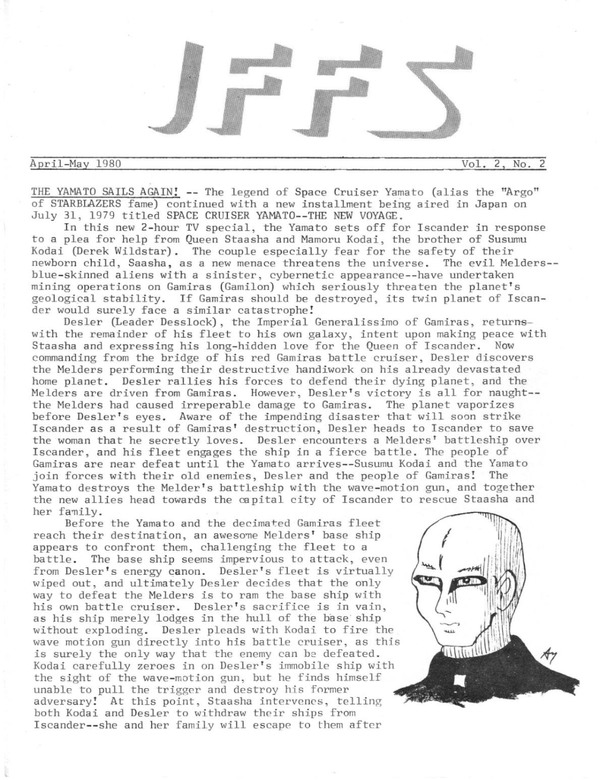
Desler — Yamato 3 synopsis — JFFS V2N5:2–3; Yamato III characterization and continuity — JFFS V2N6:2; Garuman emperor, Yamato III plot and Kodai meeting — JFFS V2N8:3–4; Yamato III ending; Garuman leader, Hyper-Desler Cannon and defense of Yamato — JFFS V3N1:2–4; Desler (Yamato): Garuman-Gamiras leader referenced in teaser synopsis — JFFS V3N5:5; Portrait illustration signed only with initials; role in Yamato—The New Voyage — JFFS V2N2:1–2.
Destron — Villain in Kamen Rider V-3 origin account — JFFS V3N4:6.
Destroy All Monsters — Varan puppet head; convention trailer — JFFS V3N6:2–3.
Dewey (Silent Running) — Small replica on sale at convention — JFFS V3N5:4.
Diamos, Fighting General — series in Tadao Nagashima obituary — JFFS V2N8:1.
Dicken, Roger — Effects designer reportedly approached for proposed American Ultraman film — JFFS V3N1:1.
Dinosaurs — Demons and mutated dinosaurs in proposed Ultraman film screenplay — JFFS V3N1:1.
Domon — Yamato III battle and character synopsis — JFFS V2N6:2; Domon, Daisuke: Yamato III character portrait — JFFS V2N8:3; Yamato III; rescues Luda and repairs Hydro-Cosmojin controls — JFFS V3N1:2–4.
Doraemon — animated film double-bill report — JFFS V2N6:3; Nobita no Uchu Kaitaku Shi movie synopsis — JFFS V2N8:1; Sapporo Ice Festival sculpture — JFFS V2N8:4; New animated feature reported in production — JFFS V3N3:5; New spring theatrical adventure — JFFS V3N4:4; Nobita no Kyoryu (Nobita’s Dinosaur): release, synopsis and illustrations — JFFS V2N2:2–3.
Doraemon Nobita no Kyoryu — Animated film synopsis and Page 3 illustrations — JFFS V2N2:2–3.
Dougram — Giant-robot television show — JFFS V3N4:4; Animation merchandise in Osaka shop — JFFS V3N5:5.
Dr. Slump — 1982 theatrical film notice — JFFS V3N4:4.
Dragonslayer — Go-Motion techniques praised in special-effects discussion — JFFS V3N5:3; Effects clips shown at convention all-night video event — JFFS V3N6:3.
E
Earthquake Islands — New Toho disaster film reported; effects and music — JFFS V2N4:3.
Eilke, Jeanette — Japanese Fantasy in Canada report — JFFS V2N5:3; Japanese fantasy television in Europe contributor — JFFS V2N8:4.
Eleking — Ultraman ’80 returning monster — JFFS V2N8:2.
English translations, film scripts — Original Japanese Godzilla screenplay available; other films proposed — JFFS V3N6:6.
Environmental catastrophe (cinema) — Catastrophe: 1999 plot and U.S. television version — JFFS V2N9:3.
Esmeraldus, Queen — Expected appearance in Adieu Galaxy Express 999 — JFFS V3N1:4.
F
Fang, Joey — Performer named in reported Star Godzilla advertisement — JFFS V2N4:2.
Fanzine publicity — JFFS invitation to other organizations — JFFS V2N9:5.
Fanzines—Japanese special-effects fandom — Convention display, prices, production stills, hand-lettered editions — JFFS V3N5:3–4.
Film production budgets — Ultraman--Hero from the Stars reported $3.5 million budget — JFFS V3N1:1.
Filmra — Denjiman adversary, JFFS V2N3:4.
Final Yamato — Yamato—The Final Voyage: Planned 1983 closing film; reported Vulcan Empire storyline — JFFS V3N4:2, 5; Yamato—The Final Voyage: Proposed 1983 movie and detailed advance teaser synopsis — JFFS V3N5:5; Artwork: Final Yamato characters: Lugar II, Lugar, Queen of Aquarius; no full attribution — JFFS V3N6:5–6; Release, detailed plot synopsis, character illustrations and criticism — JFFS V3N6:5–6; Yamato, Final: See Final Yamato — JFFS V3N6:5–6.
Forbidden Planet — Id monster referenced in convention opening animation — JFFS V3N6:2.
Four Jackers — Japanese television rebroadcast; spelling as printed — JFFS V3N1:4.
Francis Parker Japanese Cinema — Demon Pond screening — JFFS V2N5:1; January 22–23 Magnitude 7.9 and Ambush screenings; address printed — JFFS V3N5:6; Demon Pond screening notice — JFFS V2N4:3.
Frankenstein Conquers the World — Rare unused footage of Frankenstein fighting giant octopus — JFFS V3N6:3–4.
Frankenstien monster — Mighty Atom episode (source spelling) — JFFS V2N6:1.
Frau Baw — Mobile Suit Gundam plot — JFFS V2N9:1–2.
Frausuki — sun-saving mission and death in Yamato III plot — JFFS V2N8:3.
Fu Moon — Animated television special; Rock, Kenichi, Dichi, Hide Oyaji, Gamata, Rokoko — JFFS V2N4:2.
Fujiko-Fujio — Writer-artist team credited for Doraemon — JFFS V2N2:2–3.
Fukasaku, Kinji — Joe the Sea Petrel, director named in news report — JFFS V2N5:3.
Fumiake, Mach — Professional wrestler identified as Kilara in Super Monster review — JFFS V3N3:4.
G
Gaidel, General — Yamato III name correction from prior newsletter — JFFS V2N8:2.
Gaira — War of the Gargantuas original Japanese version and scenes — JFFS V3N6:4.
Galaxy Express 999 — See Adieu Galaxy Express 999 — JFFS V3N1:4; Series comparison with Queen of a Thousand Years; dream sequence in Super Monster — JFFS V3N3:1, 4; U.S. theatrical release through New World Pictures; film, television background and Japanese poster art — JFFS V2N4:1.
Galaxy Express 999--Part II — 1981 movie news (printed title format) — JFFS V2N6:1.
Galaxy Express/Captain Harlock Fan Club — contact notice — JFFS V2N5:4.
Gamera — series and character discussed, JFFS V1N1:4; See Gammera (as printed), including anatomy supplement and Super Monster — JFFS V3N3:2–4, 6; Gamera advertisement: Reproduced full-page Shochiku English-language promotional image — JFFS V3N3:2; See also Gammera.
Gamera, the Invincible — film discussed, JFFS V1N1:4; See also Gammera.
Gamiras — Yamato—The New Voyage; parenthetical Gamilon name — JFFS V2N2:1–2.
Gammera — Space Monster Gammera — Planned film report, JFFS V2N1:2; Coal organ (Gammera): Anatomical label on JFFS Supplement 4 — JFFS V3N3:6; Super Monster review and anatomy supplement; printed double-m spelling — JFFS V3N3:3–4, 6; Gammera anatomy: JFFS Supplement 4; cross-section, measurements, origin and organ labels — JFFS V3N3:6; Gammera vs. Zigra: Reused combat footage detailed in Super Monster review — JFFS V3N3:4; Heat muscles (Gammera): Supplement 4 anatomy; muscles harden under heat — JFFS V3N3:6; Heat-energy bowel (Gammera): Supplement 4 anatomy; return of processed substances to energy — JFFS V3N3:6; Heat-energy heart (Gammera): Supplement 4 anatomical label — JFFS V3N3:6; High-temperature furnace (Gammera): Supplement 4 organ label for heat production — JFFS V3N3:6; Petroleum organ (Gammera): Anatomical label on Supplement 4 describing fuel processing — JFFS V3N3:6; Uchu Kaiju Gamera (Super Monster): recycled footage, effects and Japanese reception; Gammera wording retained — JFFS V2N2:2; See also Gamera.
Garma — Mobile Suit Gundam antagonist in plot synopsis — JFFS V2N9:1–2.
Garman — Yamato 3 synopsis — JFFS V2N5:2–3.
Garuman — Yamato III opposing faction and Desler's empire — JFFS V2N6:1–2; Desler’s empire and Yamato III plot — JFFS V2N8:3–4; Yamato III empire and fleet; Desler’s leadership — JFFS V3N1:2–4.
Garuman-Gamiras Empire — Yamato—The Final Voyage plot mention — JFFS V3N5:5.
Gatchaman — La Bataille des Planetes in France and Great Britain — JFFS V2N8:4.
Gavanas — X-Bomber villain comparison with Message from Space — JFFS V2N6:3.
General Products (Osaka) — Godzilla-themed merchandise, replicas, giant metal bust — JFFS V3N5:4.
Getta Robo — Giant-robot animation reference (spelling as printed), JFFS V2N3:4.
Ghidorah, King — Convention souvenir T-shirt — JFFS V3N5:4.
Ghidrah — Mothra discussion, JFFS V1N1:4.
Gigantis, the Fire Monster — Paul Schreibman’s earlier U.S. distribution association — JFFS V3N3:5.
Gigantor — see Tetsujin Nijuhachi Go, JFFS V1N1:4; Gigantor (Tetsujin 28): model-sheet artwork — JFFS V2N5:4; See Tetsujin 28 — JFFS V3N1:4.
Gikogira — Monster in Ultraman ’80 opening episodes — JFFS V2N2:4.
Gilliam, Phil — Galaxy Express/Captain Harlock Fan Club — JFFS V2N5:4.
Glut, Don — Telephone source and screenwriter for proposed Ultraman feature — JFFS V3N1:1.
Go Shogun — Japanese animated television series in current-program report — JFFS V2N9:2; Giant-robot television series — JFFS V3N4:4.
Go-Motion — Special-effects technique discussed with Dragonslayer example — JFFS V3N5:3.
God Marz — Giant-robot television series — JFFS V3N4:4.
Godo — Phoenix 2772 main character and portrait, JFFS V2N3:2–3.
Godzilla — film series and thematic discussion, JFFS V1N1:4; Monthly-meeting film screening, JFFS V2N1:1; proposed new films and compilation, JFFS V2N1:2; Mentioned in Tezuka’s remarks to Chicago audience, JFFS V2N3:1; report on plans for a new film — JFFS V2N5:4; planned new film, prospect and rumors reported — JFFS V2N6:1; Mosura Tai Gojira reissue/double bill — JFFS V2N6:3; proposed Toho 50th-anniversary film rumor with no further reported developments — JFFS V2N9:4; Plans to offer Japanese soundtrack records — JFFS V3N1:4; Unmade Star Godzilla promotion and proposed Japanese winter festival screenings — JFFS V3N3:1, 4; Godzilla film festival: Projected winter showings of all fifteen Japanese Godzilla films — JFFS V3N3:4; Proposed new production; prior unmade projects; newspaper reprint — JFFS V3N4:1–3; Godzilla 25th anniversary: 1979 festival and associated merchandising — JFFS V3N4:2–3; Revival rumors; fans’ debate; merchandise and model kits; subtitled U.S. tour — JFFS V3N5:1, 3–4, 6; Godzilla costume: Home-made fan costume cited among 3-Dian projects — JFFS V3N5:5; Godzilla fan clubs: Committee for Godzilla’s Revival and fan disagreements — JFFS V3N5:1, 3; Godzilla model kits: General Products and large limited-edition model figures — JFFS V3N5:4; Japanese Godzilla festival: Ten re-releases; related anniversary publicity — JFFS V3N6:5; Depicted in Star Godzilla advertisement (reported project) — JFFS V2N4:1–2.
Godzilla (1954) — Subtitled original film touring the United States; Chicago showing — JFFS V3N5:6; Original Japanese screenplay translated for JFFS members — JFFS V3N6:6.
Godzilla (American version) — Japanese re-release trailer of the American version at convention — JFFS V3N6:2–3.
Godzilla revival, American (Steve Miner) — Proposed 3-D stop-motion film; script, team and Toho permission — JFFS V3N6:4–5.
Godzilla revival, Japanese (1984 proposal) — 1984 Godzilla anniversary film: Toho production plan reported — JFFS V3N6:5; Toho anniversary-film report, festival and provisional title — JFFS V3N6:5; Toho 30th anniversary Godzilla film: See Godzilla revival, Japanese — JFFS V3N6:5.
Godzilla Show Movie — Proposed anthology (reported dropped), JFFS V2N1:2; Abandoned compilation / retrospective project — JFFS V3N4:2.
Godzilla Versus a Big Dog — Spoof film synopsis explicitly labeled fictitious — JFFS V3N4:1.
Godzilla vs. Gargantua — Rumored project, also called Godzilla vs. the Devil, JFFS V2N1:2.
Godzilla vs. Gigan — Japanese television broadcast notice — JFFS V3N1:4.
Godzilla vs. Megalon — Japanese television premiere reported August 9, 1981 — JFFS V2N9:2; Godzilla versus Megalon: Convention trailer — JFFS V3N6:3.
Godzilla vs. the Devil — Rumored project (alias Godzilla vs. Gargantua), JFFS V2N1:2; Unrealized reported 1978 UPA/Saperstein project — JFFS V3N4:2.
Godzilla vs. the Smog Monster — Godzilla versus the Smog Monster: Convention trailer — JFFS V3N6:3.
Godzilla vs. the Thing — Announced March 1980 rerelease, later cancelled according to newsletter — JFFS V3N4:2; Model bust and kit based on 1964 film — JFFS V3N5:4; Convention trailer and previously unseen missile sequence — JFFS V3N6:3; Mosura Tai Gojira theatrical rerelease; reproduced promotional artwork — JFFS V2N2:3; See also Mosura Tai Gojira.
Godzilla's Revenge — film discussed, JFFS V1N1:4.
Godzilla, King of the Monsters — film discussed, JFFS V1N1:4.
Godzilla, King of the Monsters in 3-D — See proposed American Steve Miner film — JFFS V3N6:4–5.
Godzilla—No Nukes cartoon — Godzilla cartoon—No Nukes: Newspaper cartoon beside Andrew Horvat article; artist not fully legible — JFFS V3N4:3; No Nukes Godzilla cartoon: See Godzilla cartoon—No Nukes — JFFS V3N4:3.
Godziszewski, Ed — Editor-Publications, JFFS V1N1:3; JFFS member referenced in report on 1979 Japan visit and signed newsletter, JFFS V2N1:2; JFFS convention attendee and firsthand reporting — JFFS V3N5:1, 3–5.
Goggle V — Japanese live-action hero television series — JFFS V3N4:5.
Gohten (The War in Space) — Original Toho miniature at convention — JFFS V3N6:1.
Gohten (UNSF spaceship) — The War in Space: plot and technical spacecraft illustration — JFFS V2N9:3–4.
Gohten spacecraft illustration — Japanese labeled technical drawing from The War in Space — JFFS V2N9:4.
Gojira — film discussed, JFFS V1N1:4; See also Godzilla (1954).
Gojira no Gyakushu — sequel discussed, JFFS V1N1:4.
Goldorak (Mazinger Z) — Canadian television coverage — JFFS V2N5:3.
Goldorak (UFO Planet Grandizer) — French television broadcasts; source title spellings — JFFS V2N8:4.
Golion — Hyakujuu Golion, five robotic lions and their pilots — JFFS V2N8:1–2.
Gomora — Ryo Takayama creature mask exhibited — JFFS V3N6:3.
Gomora 2 — Ultraman ’80 — JFFS V2N5:3.
Grays, Kevin — Battle of the Planets Fan Club — JFFS V2N5:4; JFFS member who supplied Mobile Suit Gundam plot synopsis — JFFS V2N9:1–2.
Gudmundson, Bill — cover artwork, JFFS V1N1:1; staff Art credit, JFFS V1N1:3; Signed Hedorah anatomy illustration in JFFS Supplement 1 — JFFS V2N4:4.
Gundam II — Gundam 2: Second Mobile Suit Gundam compilation film scheduled for July — JFFS V3N1:4.
Gundam III — Gundam 3: Third Mobile Suit Gundam compilation film reported in planning — JFFS V3N1:4; Animated feature in production, alternately called Mugurai: Sora — JFFS V3N3:5; Spring release and reproduced Last Shooting! advertisement — JFFS V3N4:4–5.
Gustaf, Captain — Yamato III Garuman captain sent in pursuit — JFFS V3N1:2–3.
H
Hakucho no Mizumi (Swan Lake) — Toei animated fairy-tale feature — JFFS V2N8:1.
Hanbara — Denjiman adversary, JFFS V2N3:4.
Harlock, Phantom F. — Ancestor in My Youth in Arcadia feature — JFFS V3N5:6.
Harlock, Phantom F., II — World War II pilot named in feature synopsis — JFFS V3N5:6.
Hedorah — Pollution monster referenced in Horvat Godzilla article — JFFS V3N4:3; Convention miniatures: Hedorah: Preserved plexiglass costume eyes — JFFS V3N6:2; Surviving plexiglass monster costume eyes on display — JFFS V3N6:2; JFFS Supplement 1: full-page anatomy illustration and organ labels by Bill Gudmundson — JFFS V2N4:4.
Herlock, Captain — Space Pirate–Captain Herlock; French-Canadian title Captain Albator, JFFS V2N3:4; see also Captain Harlock (variant spelling); Space Pirate Captain Herlock: spelling printed in two-part Galaxy Express 999 special — JFFS V2N4:1; See also Captain Harlock.
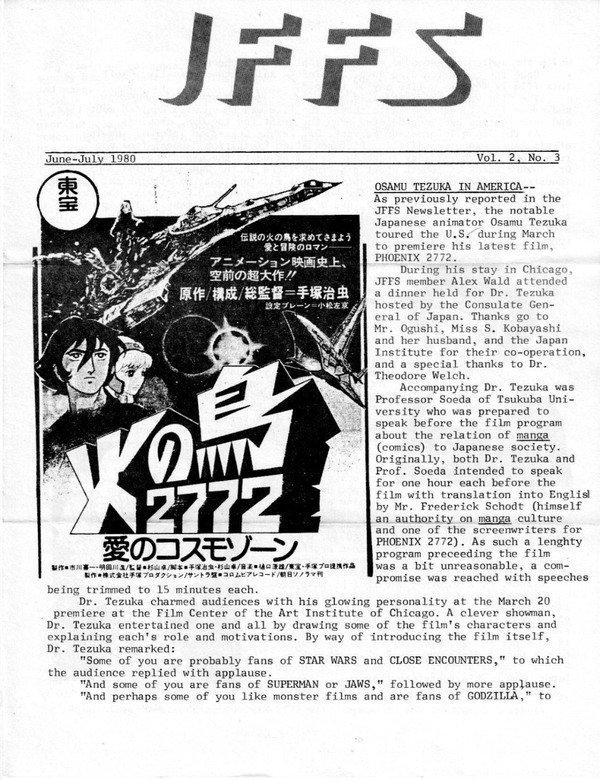
Hi no Tori 2772 — See Phoenix 2772; Japanese promotional poster, JFFS V2N3:1.
Hige Oyaji — Character mentioned in Phoenix 2772 report, JFFS V2N1:1.
Higuchi, Yasuo — music credit reproduced in Space Firebird promotional artwork — JFFS V2N9:5.
Hijiri, Saki — JFFS member cited in possible new Godzilla production report — JFFS V2N6:1; Uchusen magazine and three-dimensional model-making fandom — JFFS V3N5:4.
Hiramatsu, Yuji — Yuji Hiramatsu: Books Nippon contact for Starblazers comics — JFFS V3N6:6.
Hirata, Akihiko — Akihiko Hirata: Godzilla 30th-anniversary festival; appearance in Dr. Serizawa costume — JFFS V3N6:5.
Honda, Ishiro — Comments about proposed Godzilla film, JFFS V2N1:2; Kagemusha production coordinator, as reported — JFFS V2N6:3; Film director interviewed in reprinted AP Godzilla article — JFFS V3N4:3; Ishiro Honda: Wonder Film Contest presentation; stage appearance — JFFS V3N6:3–4.
Horvat, Andrew — Associated Press report on new Godzilla film and nuclear-age themes — JFFS V3N4:3.
House — Psychological horror film; Japanese television premiere notice — JFFS V3N3:5.
Hsu, Fuhen — Director credit in reported Star Godzilla advertisement — JFFS V2N4:2.
Hsu, Joy — Producer credit in reported Star Godzilla advertisement — JFFS V2N4:2.
Human Tarantula — Announced accompanying martial-arts film at Demon Pond screenings — JFFS V2N4:3.
Hydro-Cosmojin — Weapon employed to restore Earth’s sun in Yamato III — JFFS V3N1:3–4.
Hyper-Desler Cannon — Desler’s weapon in Yamato III finale — JFFS V3N1:3.
I
Ideon — robot illustration — JFFS V2N8:2; New animated feature reported in production — JFFS V3N3:5; Current animation merchandise in Osaka — JFFS V3N5:5.
Ifukube, Akira — Rumored return to compose a proposed Godzilla score — JFFS V3N4:2; Rumored composer of new Godzilla film, explicitly unconfirmed — JFFS V3N5:1; Akira Ifukube: Music at convention opening; Godzilla festival concert — JFFS V3N6:2, 5.
Ikebe, Ryo — The War in Space actor identified in review — JFFS V2N9:4.
Invisible Man — Daiei and Toho fantasy films, JFFS V1N1:4.
Invisible Man Appears — film discussed, JFFS V1N1:4.
Invisible Swordsman — film discussed, JFFS V1N1:4.
Iscander — Yamato—The New Voyage storyline — JFFS V2N2:1–2.
Ishiguro, Noboru — art credit reproduced in Space Firebird promotional artwork — JFFS V2N9:5.
Ishimori Productions — Sky Rider illustration caption, JFFS V2N3:4; Next Kamen Rider reportedly under preparation — JFFS V3N3:4.
Ishimori, Shotaro — Cyborg 009: Legend of Super Galaxy, producer named in news report — JFFS V2N5:3.
It Conquered the World — Monster referenced in opening film montage — JFFS V3N6:2.
Izumiya Co. — JFFS merchandise arrangement for Toei animation material — JFFS V2N9:5; Delayed merchandise orders in JFFS club notice — JFFS V3N3:5.
Izumiya Co. merchandise — posters, stills, and unpainted Toei animation cels — JFFS V2N9:5.
J
Janborg Ace — television/robot hero discussed, JFFS V1N1:4.
Japanese animation — See Adieu Galaxy Express 999, Mobile Suit Gundam, Mighty Atom, Yamato III — JFFS V3N1:2–4.
Japanese animation merchandise — posters, stills and unpainted cels offered through Izumiya — JFFS V2N9:5.
Japanese fantasy film — historical overview, Alex Wald, JFFS V1N1:3–4.
Japanese fantasy film screenings — Trailers, rare footage and original-language versions — JFFS V3N6:2–4.
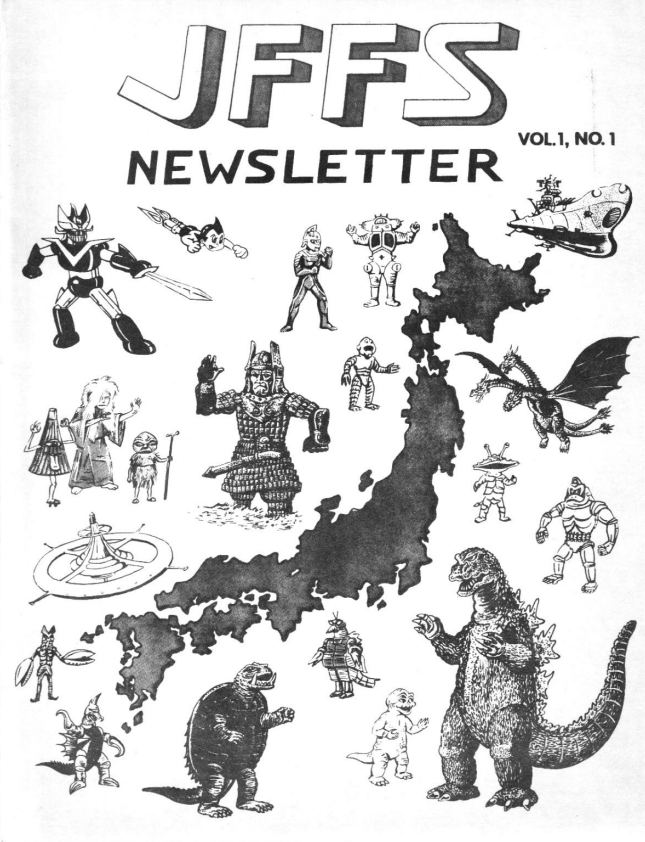
Japanese Fantasy Film Society — aims, activities, membership and origin, JFFS V1N1:2–3; member benefits and merchandise, JFFS V1N1:2–3; monthly newsletter and yearbook proposals, JFFS V1N1:2–3; screenings and film prints, JFFS V1N1:3; staff credits, JFFS V1N1:3; JFFS: meetings and film screenings — First monthly meeting, Columbia College, JFFS V2N1:1; JFFS: membership and merchandise — Merchandise offers, member correspondence, and future mailings, JFFS V2N1:2; JFFS membership directory: Planned for members enrolled through July, JFFS V2N3:4; newsletter publication schedule — JFFS V2N5:4; screenings and film programs — JFFS V2N5:1, 4; yearbook and submissions — JFFS V2N5:1; proposed Chicago mini-convention — JFFS V2N6:3; JFFS Supplement 2 (Angilas) — JFFS V2N6:4; Bookshelf records, orders and delivery information — JFFS V2N8:4; membership renewal, $10 dues and Yearbook — JFFS V2N8:4; newsletter publication delay, limited Japanese news sources — JFFS V2N9:5; Yearbook delays and promised member copies — JFFS V2N9:5; Izumiya Co. animation-material merchandise arrangement — JFFS V2N9:5; solicitation of clubs and fanzines for publicity — JFFS V2N9:5; JFFS membership: Editorial thanks for renewals and invitations for comments — JFFS V3N1:4; JFFS record distribution: Japanese record orders and planned soundtrack availability — JFFS V3N1:4; Merchandise delay and August 1982 convention coverage plans — JFFS V3N3:5; Newsletter editorial; anticipated convention visit; member profile — JFFS V3N4:2, 4–5; Convention attendance; report; Chicago screenings; member materials — JFFS V3N5:1, 6; JFFS membership services: English film-script translations, $5 Godzilla screenplay — JFFS V3N6:6; Merchandise and promised Phoenix 2772 follow-up — JFFS V2N2:4; Monthly screening pause, member suggestions and plans to resume — JFFS V2N4:3.
Japanese fantasy in Canada — television report — JFFS V2N5:3.
Japanese film releases — Toho’s Rengo Kantai and anime theatrical films — JFFS V3N1:4.
Japanese film, original-versus-US cuts — War of the Gargantuas music, editing differences — JFFS V3N6:4.
Japanese folklore — Shinto legends, ghosts, demons and monsters in film, JFFS V1N1:3–4.
Japanese television — Current-series and repeat-program notices — JFFS V3N1:4.
Japanese television—giant robots — Commentary and title list — JFFS V3N4:4–5.
Jein, Greg — miniature submarine for Virus — JFFS V2N6:3.
JFFS Supplements — Japanese Fantasy Film Society supplements: Supplement 3: Twin Tail anatomy — JFFS V2N9:6; Japanese Fantasy Film Society supplements: Supplement 4: Gammera anatomy sheet — JFFS V3N3:6; Supplement 1, Hedorah anatomy sheet by Bill Gudmundson — JFFS V2N4:4.
JFFS Yearbook — JFFS Yearbook (1980): Promised detailed Phoenix 2772 treatment, JFFS V2N3:3; Yearbook, JFFS: delay and anticipated delivery to members; completion not documented — JFFS V2N9:5.
Jittlov, Mike — Wizard of Speed and Time presentation — JFFS V3N6:4.
Joe the Sea Petrel — upcoming Toei production — JFFS V2N5:3.
Jyuzo Okita — Final Yamato plot: return of Yamato captain — JFFS V3N6:6.
K
Kagemusha (The Shadow Warrior) — Toho box-office report and production credits — JFFS V2N6:3.
Kai Shiden — Mobile Suit Gundam plot synopsis — JFFS V2N9:1–2.
Kaichi — Young turtle-loving protagonist of Super Monster synopsis — JFFS V3N3:3.
Kaida, Yuuji — Convention organizer introducing opening film — JFFS V3N6:2.
Kaiyodo Hobby Con — Osaka model company selling science-fiction and kaiju kits — JFFS V3N5:4.
Kamen Rider — television superhero series discussed, JFFS V1N1:4; Announcement of a prospective tenth masked rider — JFFS V3N3:4; Convention fanzines and costume replicas — JFFS V3N5:4–5; Convention attendees in superhero regalia — JFFS V3N6:1; Sky Rider report and flying motorcycle — JFFS V2N2:4.
Kamen Rider Bromide Zukan — Merchandise available, JFFS V2N1:2.
Kamen Rider S-1 (Super One) — television report (spelling as printed) — JFFS V2N5:3; Kamen Rider Super-1: Yoko Shimada cast connection to Shogun — JFFS V2N8:2.
Kamen Rider V-3 — Kamen Raida V·3: JFFS Supplement 5; printed title and character origin — JFFS V3N4:6; See Kamen Raida V·3 (printed title variant) — JFFS V3N4:6; Kamen Rider V-3 illustration: Uncredited full-figure supplement drawing — JFFS V3N4:6; Kamen Rider V-3 powers: Eleven named special abilities in JFFS Supplement 5 — JFFS V3N4:6.
Kilara — Space Woman and pet-shop keeper in Super Monster; role played by Mach Fumiake — JFFS V3N3:3–4.
Kimba the White Lion — Tezuka character mentioned, JFFS V2N1:1.
King Ghidorah — Animated in convention opening 8mm film; Maser-cannon attack — JFFS V3N6:2.
King Kong — influence on monster filmmaking discussed, JFFS V1N1:4; Di Laurentiis-style Kong in Star Godzilla publicity image — JFFS V3N3:1; Depicted in reported Star Godzilla advertisement — JFFS V2N4:1–2.
King Kong Escapes — Convention trailer — JFFS V3N6:3.
King Kong vs. Godzilla — Large model on convention display — JFFS V3N5:4; Convention trailer — JFFS V3N6:3.
Kitagawa — Rumored Godzilla special-effects director; linked with Star Wolf — JFFS V3N4:1–2.
Kobayashi, Tetsuko — Empress of Mu performer in convention finale — JFFS V3N6:3–4.
Kodai — Yamato Be Forever and Yamato 3 — JFFS V2N5:2–3; Yamato III design changes — JFFS V2N6:2; Kodai, Susumu: Yamato III storyline — JFFS V2N8:3–4; Kodai, Susumu: ice sculpture at Sapporo Ice Festival — JFFS V2N8:4; Yamato III finale and Sharubart encounter — JFFS V3N1:2–4; Mamoru and Susumu Kodai in Yamato—The New Voyage — JFFS V2N2:1–2; Mamoru Kodai in Yamato: Be Forever synopsis — JFFS V2N4:3.
Kresent — Monster in Ultraman ’80 opening episodes — JFFS V2N2:4.
Kurosawa, Akira — Kagemusha director — JFFS V2N6:3.
L
La Bataille des Planetes — French television version of Gatchaman — JFFS V2N8:4.
Laiza — Galaxy Express 999 two-part television special — JFFS V2N4:1.
Latitude Zero — Convention miniatures: Latitude Zero: Diving bell miniature on display — JFFS V3N6:1; Original Toho diving-bell miniature displayed — JFFS V3N6:1.
Lee, Chris — Screenplay credit in reported Star Godzilla advertisement — JFFS V2N4:2.
Lena — Phoenix 2772 synopsis, JFFS V2N3:2.
Liberty Island — Proposed Ultraman--Hero from the Stars battle location — JFFS V3N1:1.
Luda, Princess — Yamato III heroine and identity as Mother Sharubart — JFFS V3N1:2–3; illustration — Captioned portrait; unidentified artist — JFFS V3N1:2.
Lugar — Final Yamato character and illustration; Deingil ruler — JFFS V3N6:5–6.
Lugar (Yamato) — Ruler of Deingil; conquest plans in teaser plot — JFFS V3N5:5.
Lugar II — Final Yamato character and labeled illustration — JFFS V3N6:5.
Lum — Urusei Yatsura character and reproduced illustration — JFFS V3N5:6.
Lupin III—Cagliostro Castle — Proposed English screenplay translation — JFFS V3N6:6.
M
Mach Baron — television robot discussed, JFFS V1N1:4.
Maeter — Adieu Galaxy Express 999 plot; spelling as printed — JFFS V3N1:4; Queen of a Thousand Years comparison and Saraba Galaxy Express 999 discussion — JFFS V3N3:1; Galaxy Express 999 character — JFFS V2N4:1.
Magma Alien — Monster identified in Andros Melos report — JFFS V3N3:5.
Magnitude 7.9 — Japanese 1980 film advertised for Chicago screening; cast / crew information — JFFS V3N5:6.
Majin — Japanese movie soundtrack records proposed for JFFS members — JFFS V3N1:4; Ryo Takayama creature mask displayed — JFFS V3N6:3.
Majin, the Great Demon God — fantasy film discussed, JFFS V1N1:4.
Man in the Moonlight Mask — Japanese television hero, JFFS V1N1:4; The Man in the Moonlight Mask: Moon Mask Rider film preview — JFFS V2N5:1–2.
Maser cannon — Remote-controlled model exhibited by Japanese fans — JFFS V3N5:5; War of the Gargantuas original and fan-made models; opening film — JFFS V3N6:1–2.
Matsuda, Yusaku — Joe the Sea Petrel, actor named in news report — JFFS V2N5:3.
Matsumoto, Reiji — Space Pirate–Captain Herlock credited to him, JFFS V2N3:4; Queen of a Thousand Years television series and Galaxy Express 999 feature — JFFS V3N3:1; My Youth in Arcadia / Captain Harlock — JFFS V3N5:5–6; Poster illustration for Mosura Tai Gojira attributed to him by the newsletter — JFFS V2N2:3; Galaxy Express 999 production context — JFFS V2N4:1; Yamato: Be Forever production credit — JFFS V2N4:2.
Mazinger — comparison with X-Bomber antagonist design — JFFS V2N6:3; animated television in France — JFFS V2N8:4.
Mazinger Z — animated robot series discussed, JFFS V1N1:4.
Melders — Adversaries in Yamato—The New Voyage — JFFS V2N2:1–2.
Merchandising — Mobile Suit Gundam model-kit demand — JFFS V3N1:4.
Message from Space — X-Bomber visual and effects comparisons — JFFS V2N6:3.
Metropolis — Robotrix miniature at convention — JFFS V3N5:4.
MGM — announced prospective U.S. release of Phoenix 2772 as Space Firebird — JFFS V2N9:4–5.
Mighty Atom — Mighty Atom (Astro Boy): television animation discussed, JFFS V1N1:4; Tezuka character mentioned, JFFS V2N1:1; comics offered to members, JFFS V2N1:2; Osamu Tezuka television series news and origin account — JFFS V2N6:1; Atom, Mighty: correction: Atom kidnapped by Dr. Tenma — JFFS V2N8:2; correction to episode plot involving Dr. Tenma — JFFS V2N8:2; Sapporo Ice Festival ice sculpture — JFFS V2N8:4; Atom: See Mighty Atom and Atlas reports — JFFS V3N1:4; Japanese television episodes, baseball hiatus and Atlas rivalry — JFFS V3N1:4; 1980 roadshow sharing billing with Super Monster — JFFS V3N3:4; Tetsuwan Atom rerelease with Uchu Kaiju Gamera — JFFS V2N2:2; Tetsuwan Atom television return, two-hour special and new series news — JFFS V2N4:2.
Mighty Jack — Subject of Japanese convention fanzines — JFFS V3N5:4.
Miner, Steve — Steve Miner: American 3-D Godzilla project reported, proposed 1984 release — JFFS V3N6:4–5.
Mini-conventions — JFFS Chicago proposal and date choices — JFFS V2N6:3.
Miniature effects, Toho — Prop history and deterioration at convention displays — JFFS V3N6:1–2.
Mirror Man — Tsuburaya Japanese television rerun — JFFS V2N9:2.
Mishune, Akira — Name printed in spoof Godzilla Versus a Big Dog synopsis — JFFS V3N4:1.
Miss America — Battle Fever J character in stage finale — JFFS V3N6:4.
Miyagawa, Hiroshi — Arranger of Yamato—The Final Voyage score based on LP — JFFS V3N5:5; Yamato: Be Forever music credit — JFFS V2N4:2.
Mizuno, Kumi — Kumi Mizuno: War of the Gargantuas scene discussed — JFFS V3N6:4.
Mobile Suit Gundam — proposed theatrical compilation, March 1981 — JFFS V2N6:1; robot and human character illustrations — JFFS V2N6:3; Gundam, Mobile Suit: Shochiku animated feature compiled from episodes 1–5 — JFFS V2N8:1; Gundam, Mobile Suit: Sapporo Ice Festival ice sculpture — JFFS V2N8:4; Gundam merchandise: major merchandising campaign described in newsletter — JFFS V2N9:2; Gundam theatrical films: second compilation movie reception and third movie plans — JFFS V2N9:2; Gundam, Mobile Suit: film synopsis, theatrical compilation reception and merchandising — JFFS V2N9:1–2; Gundam, Mobile Suit: Gundam drawings and Char Aznable portrait — JFFS V2N9:1; Mobile Suit Gundam: The Movie: first and second theatrical compilation reception — JFFS V2N9:2; Gundam model kits: Japanese consumer demand and merchandising — JFFS V3N1:4; Mobile Suit Gundam: The Movie: Theatrical compilation of episodes 1–13, reception and sequels — JFFS V3N1:4; Gundam: Current animation shop merchandise — JFFS V3N5:5.
Monkey Island — historical fantasy film discussed, JFFS V1N1:3.
Moon Mask Rider — film preview — JFFS V2N5:1–2; announced 1981 release — JFFS V2N6:1; Sapporo Ice Festival ice sculpture — JFFS V2N8:4.
Moore, Roger — Named in spoof Godzilla Versus a Big Dog synopsis — JFFS V3N4:1.
Mosura Tai Gojira — announced March double-bill with Doraemon (printed title) — JFFS V2N6:3; Theatrical rerelease (Godzilla vs. the Thing) — JFFS V2N2:3; See also Godzilla vs. the Thing.
Mother Sharubart — Yamato III character and Sharubart mythology — JFFS V3N1:2–3.
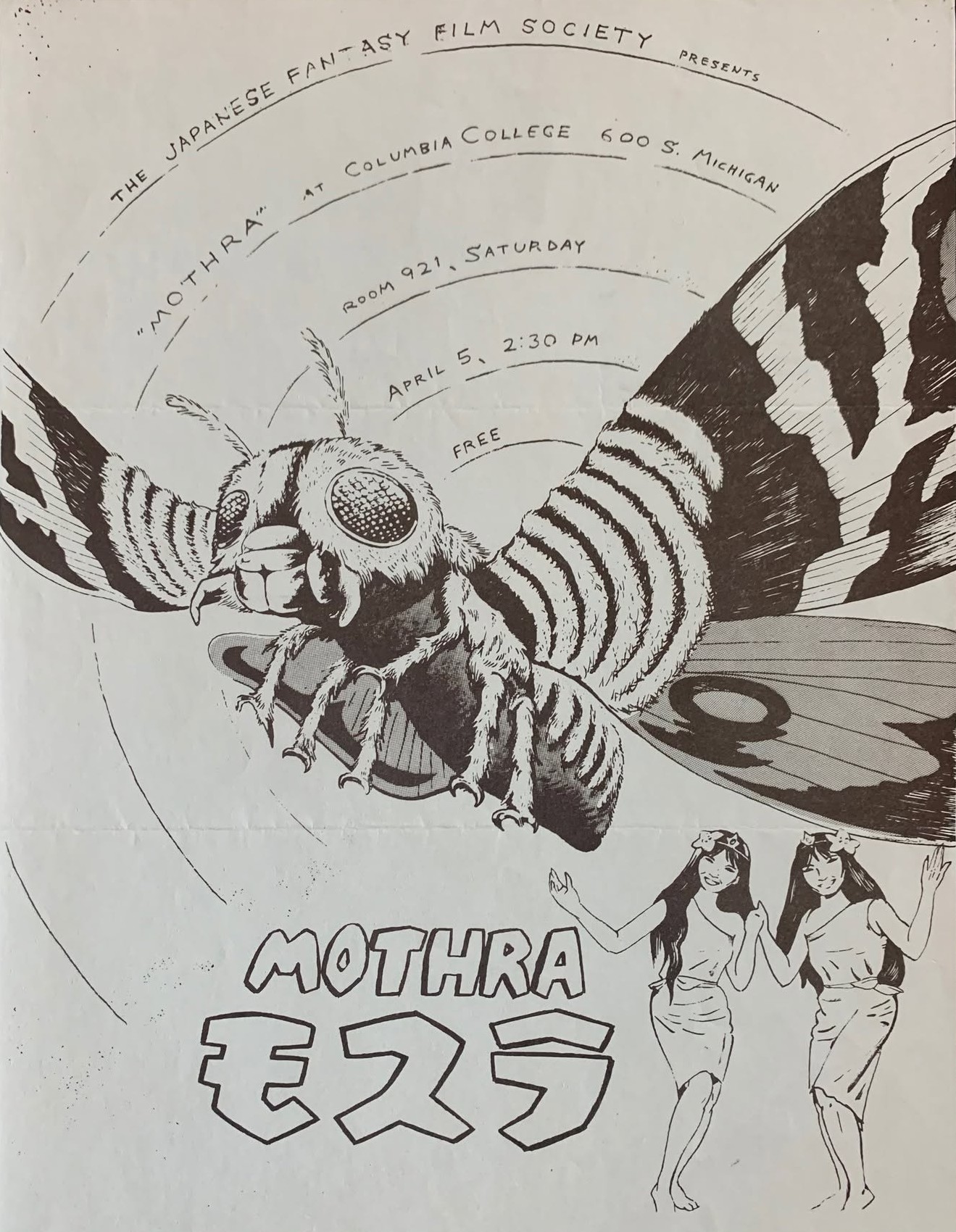
Mothra — discussion of monster design and themes, JFFS V1N1:4; Larval monster model kit at convention — JFFS V3N5:4.
Mount Rushmore — Rejected Superman II scene compared with proposed Ultraman Statue of Liberty scene — JFFS V3N1:1.
Mugurai: Sora — Alternate title given for Gundam III; spelling as printed — JFFS V3N3:5.
Music TV — American cable presentation of Super Monster in October 1981 — JFFS V3N3:3.
Muteki Robo Traidar G — Giant-robot animation news, JFFS V2N3:4.
My Youth in Arcadia — Japanese theatrical feature and Harlock-family synopsis — JFFS V3N5:5–6; Proposed English screenplay translation — JFFS V3N6:6.
N
Nagashima, Tadao — obituary; animated television and Ulysses 31 — JFFS V2N8:1.
Nakamura, Kazuko — art credit in reproduced Space Firebird publicity — JFFS V2N9:5.
Nakano, Shokei — Effects credit on Magnitude 7.9 notice (as printed) — JFFS V3N5:6.
Nakano, Teruyoshi — Special effects direction for Toho’s Rengo Kantai — JFFS V3N1:4; Rumored Godzilla effects director; comparison with Kitagawa — JFFS V3N4:1–2; Earthquake Islands special effects credit — JFFS V2N4:3.
National Kid — television superhero discussed, JFFS V1N1:4.
NBC Today Show — 1981 Sapporo Ice Festival television coverage — JFFS V2N8:4.
Neo Feras — Fan club exhibiting superhero masks and costumes — JFFS V3N6:3.
New Godzilla film (1982 rumors) — Proposed Toho fiftieth-anniversary production, unconfirmed — JFFS V3N4:1–2.
New World Pictures — American theatrical release of Galaxy Express 999 — JFFS V2N4:1.
Niisan Takahashi — Screenplay credit on reproduced Super Monster graphic — JFFS V3N3:3.
Nippon Herald Films — Moon Mask Rider — JFFS V2N5:1.
Nishizaki, Yoshinobu — Producer; explanation of Yamato III abridgment; future film plans — JFFS V3N4:5; Producer; editorial criticism of expanded Final Yamato — JFFS V3N6:6; Yamato: Be Forever production credit — JFFS V2N4:2.
North Polar Sea — Location of Gammera discovery in anatomy supplement — JFFS V3N3:6.
Northwestern University — Scheduled Tezuka appearance, JFFS V2N1:1.
Nostradamus no Dayogen — Toho film Catastrophe: 1999, renamed The Last Days of Planet Earth for U.S. television — JFFS V2N9:2–3.
Nuclear war (film depiction) — American editing of Catastrophe: 1999 / The Last Days of Planet Earth — JFFS V2N9:3.
O
Octopus Bones — historical fantasy film discussed, JFFS V1N1:3.
Octopus, giant (Frankenstein) — Deleted giant-octopus ending footage screened at convention — JFFS V3N6:3–4.
Ohbayashi, Nobuhiko — Short story Space Godzilla referenced from Japanese Starlog, JFFS V2N1:2.
Ohmori, Kenjiro — Director of Magnitude 7.9 (as printed) — JFFS V3N5:6.
Okaojara Kunio — Mobile Suit Gundam mechanical designer named; spelling as printed — JFFS V2N8:1.
Olga — Phoenix 2772 character and illustration, JFFS V2N3:2–3.
Onchi, Hideo — Director of Chikyu E... (Toward the Terra) — JFFS V2N2:3.
Origins of the Japanese Fantasy Film — article by Alex Wald, JFFS V1N1:3–4.
Osaka animation shops — Toei Animation store; film / television merchandise — JFFS V3N5:5.
Osaka fan merchandise — General Products and Kaiyodo model makers — JFFS V3N5:4.
Otasukeman — Successor to Yatterman and Sendaman, JFFS V2N3:4.
P
Panda and the Magic Serpent — animated film discussed, JFFS V1N1:3.
Paul, Mike — 1979 Japan visit with Ed Godziszewski reported, JFFS V2N1:2.
Phantom (planet) — Yamato III storyline and supernatural manifestations — JFFS V2N8:3–4; Yamato III illusion-generating Earth-like planet — JFFS V3N1:2.
Phoenix (Bird of Fire) — In Phoenix 2772 synopsis, JFFS V2N3:2–3.
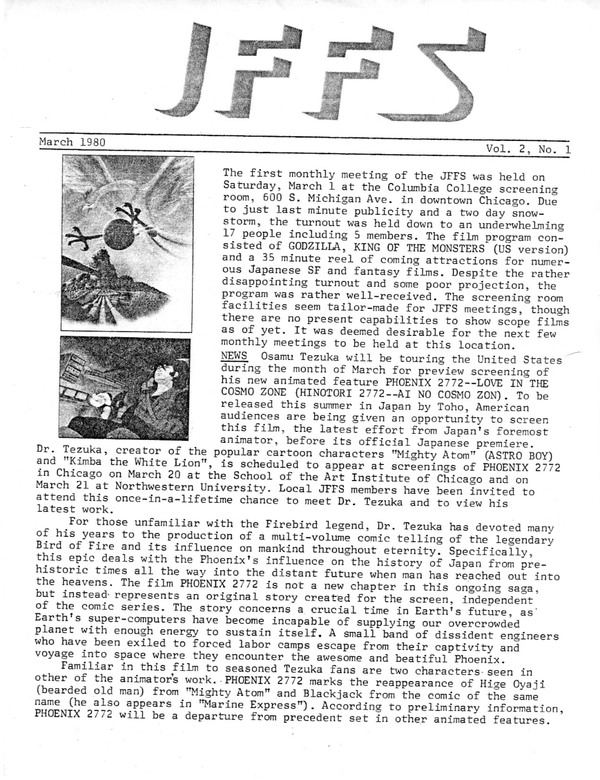
Phoenix 2772 — Love in the Cosmo Zone — Preview, synopsis, Tezuka visit and production note, JFFS V2N1:1–2; Tezuka’s Chicago film screenings and remarks, JFFS V2N3:1–2; reproduced Japanese poster, JFFS V2N3:1; plot synopsis and character illustrations, JFFS V2N3:2–3; yearbook treatment announced, JFFS V2N3:3; reported MGM U.S. release under Space Firebird title and Toho advertisement — JFFS V2N9:4–5; Opening in Japan and planned follow-up on Tezuka visit — JFFS V2N2:2.
Pictures at an Exhibition — Tezuka experimental short shown in Chicago, JFFS V2N3:2.
Pincho — Phoenix 2772 character; signed illustration, JFFS V2N3:2–3.
Pinto, Michael — Starblazers Fan Club contact in Merrick, New York — JFFS V2N9:5.
Pooks — Phoenix 2772 character, JFFS V2N3:3.
Prince of Space — television hero discussed, JFFS V1N1:4.
Princess Shirayuki — illustrated portrait from Demon Pond — JFFS V2N5:1.
Q
Queen Metalaina — Galaxy Express 999 two-part television special — JFFS V2N4:1.
Queen of a Thousand Years — Reiji Matsumoto animated television series; ratings and story discussion — JFFS V3N3:1; Queen of a Thousand Years artwork: Reproduced portrait and large title treatment — JFFS V3N3:1; Queen Millennia: Queen of 1000 Years; theatrical notice — JFFS V3N4:4; Queen of 1000 Years: Release notice and Nishizaki production reference — JFFS V3N4:4–5.
R
Ragon — Creature mask by Ryo Takayama shown at convention — JFFS V3N6:3.
Ragone, August — Source for report on planned Gammera film, JFFS V2N1:2; reported recipient of Saki Hijiri's Godzilla news — JFFS V2N6:1; report to JFFS on MGM’s planned Space Firebird release — JFFS V2N9:4–5.
Rainbow Sentai Robin — animated series discussed, JFFS V1N1:4.
Rarmetal — Planet in Adieu Galaxy Express 999 outline; spelling as printed — JFFS V3N1:4.
Raymond Burr — Actor in American version of Godzilla, discussed by Horvat — JFFS V3N4:3.
Rebirth of Godzilla — Provisional title reported for Japanese Toho revival — JFFS V3N6:5.
Red King — Ultraman ’80 guest monster — JFFS V2N8:2; Ryo Takayama creature mask displayed — JFFS V3N6:3.
Rengo Kantai — Rengo Kantai (The Grand Fleet): release notice and review of Toho naval war film — JFFS V2N9:4; See The Grand Fleet; Toho World War II film — JFFS V3N1:4; The Grand Fleet: See Rengo Kantai; Toho World War II battleship film — JFFS V3N1:4.
Rengo Kantei — Source title printed beside Magnitude 7.9 screening notice — JFFS V3N5:6.
Return of Ultraman — Twin Tail monster depicted in anatomical supplement — JFFS V2N9:6.
Robby the Robot — Forbidden Planet robot figure on sale — JFFS V3N5:4.
Rock — Phoenix 2772 character, JFFS V2N3:2.
Rodan — Small monster replica at convention — JFFS V3N5:4.
Rose of Versailles — animated series in Tadao Nagashima obituary — JFFS V2N8:1.
S
Saasha — Yamato: Be Forever character, JFFS V2N3:4; Yamato Be Forever synopsis — JFFS V2N5:2; The New Voyage character and family storyline — JFFS V2N2:1–2; Yamato: Be Forever character — JFFS V2N4:3.
Sadamebius — Tatsunoko animated space-opera series; source spelling — JFFS V2N9:2.
San Ku Kai — French television broadcasts — JFFS V2N8:4.
Sanda — War of the Gargantuas film and Japanese soundtrack discussion — JFFS V3N6:3–4.
Saperstein, Henry — Unrealized Godzilla vs. the Devil proposal — JFFS V3N4:2.
Sapporo Ice Festival (1981) — Japanese fantasy and anime character sculptures — JFFS V2N8:4.
Saraba Galaxy Express 999 — Commentary on 1981 theatrical anime feature — JFFS V3N3:1.
Saruta — Phoenix 2772 character, JFFS V2N3:3.
Sato, Masaru — composer of Rengo Kantai (The Grand Fleet), named in newsletter — JFFS V2N9:4.
Schodt, Frederick — Interpretation at Tezuka’s Chicago appearance, JFFS V2N3:1.
Schreibman, Paul — American Tsuburaya representative and Ultraman animation promoter — JFFS V3N3:5.
Science Patrol (Ultraman) — Spaceship vacuum-formed model kit — JFFS V3N5:4.
Science-fiction cinema, Japanese — 1981 release announcements — JFFS V2N6:1.
Science-fiction film trailers — Japanese Toho releases and American 1950s B-films — JFFS V3N6:2–3.
Science-fiction films on American television — Toho Catastrophe: 1999 and The War in Space releases — JFFS V2N9:2–4.
Script translations — See English translations, film scripts — JFFS V3N6:6.
Segal, Jeff — Jeff Segal: See Segal, Jeff (screenplay comparison) — JFFS V3N1:1; Superman II abandoned Mount Rushmore idea in Ultraman screenplay comparison — JFFS V3N1:1.
Sekezan — Galaxy Express 999 two-part television special — JFFS V2N4:1.
Sendaman — Predecessor show mentioned in Otasukeman discussion, JFFS V2N3:4.
Sharuba — mysterious spirit figure in Yamato III storyline — JFFS V2N8:3–4.
Sharubart — Yamato III planet, legendary arsenal and Mother Sharubart — JFFS V3N1:2–3.
Shima — Yamato III character design — JFFS V2N6:2.
Shimada, Yoko — actress linked to Kamen Rider Super-1 and Shogun — JFFS V2N8:2.
Shiro — Recipient of first two Riders’ powers in Supplement 5 — JFFS V3N4:6.
Shochiku Co. — Japanese distributor of Gundam compilation movie — JFFS V2N8:1; Shochiku Co., Ltd.: Credit on full-page Gamera space advertisement — JFFS V3N3:2.
Shogun — condensed theatrical version in Japan — JFFS V2N5:4; American miniseries dubbed into Japanese for television — JFFS V2N8:1; Yoko Shimada appearance cited with Kamen Rider Super-1 — JFFS V2N8:2.
Silent Running — Dewey robot replica for sale at convention — JFFS V3N5:4.
Sky Rider — Illustration captioned Ishimori Production’s SKY RIDER, JFFS V2N3:4; Eighth Kamen Rider series, flying motorcycle and monsters — JFFS V2N2:4.
Smith, Kyle — JFFS convention attendee and firsthand reporting — JFFS V3N5:1, 3–5.
Smokey (Zone Fighter) — Spaceship miniature on exhibit — JFFS V3N6:2.
Snake and the Silver Haired Witch — film discussed, JFFS V1N1:3.
Soeda, Professor — Tsukuba University speaker at Tezuka’s Chicago event, JFFS V2N3:1.
Soundtrack records — JFFS sales and projected Godzilla/Majin recordings — JFFS V3N1:4.
South Dakota Badlands — Proposed Ultraman--Hero from the Stars battle site — JFFS V3N1:1.
Space Corsair: Captain Albator — Canadian television coverage — JFFS V2N5:3.
Space Cruiser Yamato — Yamato, Space Cruiser: ice sculpture at Sapporo Ice Festival — JFFS V2N8:4; August 1981 television mini-festival screening of original film condensation — JFFS V2N9:2; Yamato television festival: August 1981 telecasts: Yamato Be Forever, Space Cruiser Yamato, Yamato the New Voyage — JFFS V2N9:2; Animated battleship appearance in Super Monster fantasy sequence — JFFS V3N3:4; New final film and Star Blazers source material — JFFS V3N4:2, 4; Planned English screenplay translation; anime comics — JFFS V3N6:6; The New Voyage: synopsis, American Starblazers naming and planned Yamato 3 adaptation — JFFS V2N2:1–3.
Space Cruiser Yamato Anime Comics — Books Nippon English-language Starblazers editions — JFFS V3N6:6.
Space Firebird — MGM’s announced title for Phoenix 2772; Toho poster reproduced — JFFS V2N9:4–5; Space Firebird publicity art: reproduced Toho promotional graphic — JFFS V2N9:5.
Space Giants — Japanese fantasy television discussed, JFFS V1N1:4.
Space Godzilla — Rumored project based on Ohbayashi story, JFFS V2N1:2.
Space Pirate–Captain Herlock — Canadian broadcasting as Captain Albator, Space Corsair; Reiji Matsumoto credit, JFFS V2N3:4.
Space Shark — Spaceship in Phoenix 2772 synopsis, JFFS V2N3:2–3.
Space Sherrif Garvan — Live-action Japanese series (spelling as printed) — JFFS V3N4:5.
Space Women — Three alien heroines in Super Monster; plot and critical review — JFFS V3N3:3–4.
Special effects — X-Bomber puppetry, miniatures and stop-motion — JFFS V2N6:2–3; Virus miniatures by Greg Jein — JFFS V2N6:3.
Spook Warfare — film discussed, JFFS V1N1:3.
Staasha — Yamato—The New Voyage character — JFFS V2N2:1–2; Yamato: Be Forever character — JFFS V2N4:3.
Star Blazers — Starblazers: Canadian television distribution — JFFS V2N5:3; Westchester’s planned 52-episode adaptation — JFFS V3N4:2, 4; Americanized Space Cruiser Yamato television adaptation — JFFS V2N2:1–2.
Star Blazers comics — Starblazers comics: Books Nippon announcement; contact Yuji Hiramatsu — JFFS V3N6:6.
Star Blazers Fan Club — Starblazers Fan Club: clubzine, membership dues, and Michael Pinto contact notice — JFFS V2N9:5.
Star Godzilla — Unmade film promoted in Chinese-distributor trade advertisement — JFFS V3N3:1; Reported Variety advertisement for proposed Chinese production; not established as completed — JFFS V2N4:1–2; See also Godzilla revival, Japanese (1984 proposal).
Star Godzilla advertisement — Reproduced trade advertisement showing Godzilla, Angilas, and Kong — JFFS V3N3:1.
Star of the Giants — animated series in Nagashima obituary — JFFS V2N8:1.
Star Trek II — All-night video screening, Japan release timing noted — JFFS V3N6:3.
Star Wars — Mentioned in Tezuka’s Chicago remarks, JFFS V2N3:1; comparison with and influence on The War in Space — JFFS V2N9:3–4.
Star Wolf — Japanese special-effects program associated with Mr. Kitagawa — JFFS V3N4:1.
Starlog — Issue 35 and discussion of Americanized Starblazers — JFFS V2N2:2.
Statue of Liberty — Proposed Ultraman film scene temporarily altering statue’s face — JFFS V3N1:1.
Stop-motion animation — Proposed American Godzilla effects method — JFFS V3N6:5.
Stout, Bill — Bill Stout: Preproduction sketches and storyboards for proposed American Godzilla — JFFS V3N6:5.
Submersion of Japan (Tidal Wave) — Research submarine miniature at convention — JFFS V3N6:2; Comparison in Earthquake Islands report — JFFS V2N4:3.
Sugiyama, Taku — screenplay and directing credits on reproduced Space Firebird publicity — JFFS V2N9:5.
Sun Vulcan — corrected name of live-action robot superhero program — JFFS V2N8:2; Spring theatrical compilation-film notice — JFFS V3N4:4; See also Sun Vultan.
Sun Vultan — television report (spelling as printed) — JFFS V2N5:3–4; See also Sun Vulcan.
Super Magnetic Robot Voltus V — series in Tadao Nagashima obituary — JFFS V2N8:1.
Super Monster — Gammera film; plot summary, television showing, effects and critical review — JFFS V3N3:3–4; Super Monster film graphic: Reproduced title art and credits for Daiei, Noriaki Yuasa and Niisan Takahashi — JFFS V3N3:3; Uchu Kaiju Gamera: Japanese reception and reproduced film advertisement — JFFS V2N2:2.
Super-robots — combined spacecraft in X-Bomber — JFFS V2N6:2–3.
Superman — Mentioned in Tezuka’s Chicago remarks, JFFS V2N3:1.
Superman II — Comparison with rejected Jeff Segal screenplay scene — JFFS V3N1:1.
Supermarionation — Gerry Anderson series in Japanese fan-published magazines — JFFS V3N5:4.
T
Takayama, Ryo — Ryo Takayama: Designer of creature masks displayed in convention tribute — JFFS V3N6:3.
Takemiya, Keiko — Original story for Chikyu E... (Toward the Terra) — JFFS V2N2:3.
Takemura, Yoshihiko — Named in Otasukeman report, JFFS V2N3:4.
Takikawa, Kuni — Yamato Be Forever plot synopsis — JFFS V2N5:2.
Tanaka, Tomoyuki — Godzilla production, JFFS V1N1:4; Reported comments concerning new Godzilla film, JFFS V2N1:2; Toho producer; film plans and AP newspaper interview — JFFS V3N4:2–3; Toho producer’s convention remarks; no new film confirmed — JFFS V3N5:3; Stage appearance at convention — JFFS V3N6:4; Tomoyuki Tanaka: See Tanaka, Tomoyuki — JFFS V3N6:4.
Tanba, Tetsuro — Catastrophe: 1999 performance — JFFS V2N9:3; Rengo Kantai cast credit — JFFS V2N9:4.
Tatsuro — Character named in Saraba Galaxy Express 999 discussion; spelling as printed — JFFS V3N3:1.
Tenma, Dr. — correction to Atom story — JFFS V2N8:2.
Tetsujin 28 — Tetsujin Nijuhachi Go (Gigantor): giant robot television discussed, JFFS V1N1:4; Gigantor episodes, youthful hero and giant robot challenger — JFFS V3N1:4.
Tetsuro — Galaxy Express 999 character — JFFS V2N4:1.
Tezuka Production — production company credited in Space Firebird promo — JFFS V2N9:5.
Tezuka, Osamu — U.S. visit, Phoenix 2772, and works, JFFS V2N1:1; Chicago appearances and Phoenix 2772 screenings, JFFS V2N3:1–2; animation plans discussed, p. 2; Mighty Atom television series — JFFS V2N6:1; Unico animated feature — JFFS V2N8:1; story and screenplay credits for Phoenix 2772 / Space Firebird — JFFS V2N9:5; Phoenix 2772 Japanese opening and advance notice of American-visit report — JFFS V2N2:2; Fu Moon animation special and Mighty Atom report — JFFS V2N4:2.
The Adventures of Ultraman — Animated Ultraman series proposed for American distribution — JFFS V3N3:5.
The Beast from 20,000 Fathoms — influence on Godzilla discussed, JFFS V1N1:4.
The Hundred Monsters — film discussed, JFFS V1N1:3–4.
The Legend of the Forest — Tezuka project described in period report, JFFS V2N3:2.
The Mysterians — announced Chicago screening — JFFS V2N5:4.
The Smog Monster — mentioned in monster-environment discussion, JFFS V1N1:4.
The Ultraman — Japanese animated series linked to The Adventures of Ultraman — JFFS V3N3:5; Animated series finale, Ultraman Joe returns to Earth; illustration — JFFS V2N2:4.
The War in Space — U.S. television availability, critical commentary, plot — JFFS V2N9:3–4; reprinted Toho press sheet — JFFS V2N9:3; Japanese technical spacecraft drawings — JFFS V2N9:4; The War in Space press sheet: reproduced Toho Japanese publicity — JFFS V2N9:3; War in Space: American television presentation referenced in Super Monster discussion — JFFS V3N3:3; Convention miniatures: Gohten: The War in Space space vehicle — JFFS V3N6:1; UNSF Gohten miniature displayed — JFFS V3N6:1.
The White Serpent — film discussed, JFFS V1N1:3.
The Wizard of Oz — proposed Japanese animated feature — JFFS V2N5:4.
Those Obnoxious Aliens — Anime program Urusei Yatsura, Lum and premise — JFFS V3N5:5–6.
Thunderbirds — comparison with X-Bomber — JFFS V2N5:4; comparison with X-Bomber — JFFS V2N6:2; Japanese animated adaptation of Gerry Anderson series — JFFS V3N4:5.
Times Square — Proposed Ultraman--Hero from the Stars battle location — JFFS V3N1:1.
Toei — television/animation discussion, JFFS V1N1:4; Denjiman and animation programs, JFFS V2N3:4; Swan Lake animated feature; Golion television series — JFFS V2N8:1.
Toei Animation — Toei animation: JFFS offer of posters, stills and unpainted cels — JFFS V2N9:5; Company shop visited by JFFS attendees in Osaka — JFFS V3N5:5.
Toho — Godzilla series and filmmaking, JFFS V1N1:4; new Godzilla project report (unconfirmed) — JFFS V2N6:1; 1980 box office for Kagemusha and Virus — JFFS V2N6:3; Japanese SF releases to U.S. television; anniversary Godzilla film rumor — JFFS V2N9:2–4; Rengo Kantai production and effects — JFFS V3N1:4; Toho Studios: Not involved with the unmade Star Godzilla announcement — JFFS V3N3:1; Fiftieth anniversary, new Godzilla production rumors and failed earlier announcements — JFFS V3N4:1–3; Godzilla revival rumors and convention reaction — JFFS V3N5:1, 3; Original miniatures; Godzilla 30th-anniversary planned revival — JFFS V3N6:1–2, 5.
Tokyo Movie Shinsha — Ulysses 31 Japanese/French co-production — JFFS V2N8:1.
Tsuburaya Productions — prospective Ultraman U.S.A. co-production — JFFS V2N8:2; Ultra Seven, Ultraman Taro and Mirror Man reruns — JFFS V2N9:2; Proposed Ultraman film and Andro Melos news — JFFS V3N1:1–2; Andros Melos television report and postponed American Ultraman film — JFFS V3N3:4–5; Andros Melos production — JFFS V3N4:4.
Tsuburaya, Eiji — special effects and Japanese fantasy filmmaking, JFFS V1N1:2,4; Legacy invoked in debate about Godzilla special effects — JFFS V3N4:1; Eiji Tsuburaya: Comparison with contemporary Japanese special effects techniques — JFFS V3N5:3.
Tsuburaya, Noboru — Comments on proposed Ultraman: The Jupiter Effect — JFFS V2N2:3.
Tsuburaya, Noburo — Noburo Tsuburaya: Executive producer named in Ultraman--Hero from the Stars report; spelling as printed — JFFS V3N1:1.
Tsukuba University — Professor Soeda at Tezuka presentation, JFFS V2N3:1.
Tsushima, Toshiaki — Earthquake Islands musical score credit — JFFS V2N4:3.
TV adaptation—Thunderbirds — Japanese animated adaptation report — JFFS V3N4:5.
TV Land — Magazine cited for Space Monster Gammera advertising, JFFS V2N1:2.
Twin Tail — JFFS Supplement 3 anatomical illustration from Return of Ultraman — JFFS V2N9:6; Twin Tail anatomy diagram: JFFS Supplement 3, full-page labeled creature drawing; artist uncredited — JFFS V2N9:6.
U
Uchusen Magazine — Saki Hijiri’s publication documenting 3-Dian hobby movement — JFFS V3N5:4.
Uchutaitei Godshiguma (Space Emperor God-Sigma) — Giant-robot animation discussion; original spelling, JFFS V2N3:4.
Ultra 7 — Underwater submarine miniature; two TV episodes screened — JFFS V3N6:2–3.
Ultra Seven — guest appearance in Ultraman ’80 — JFFS V2N8:2; Japanese television rerun report — JFFS V2N9:2; S-16 submarine model offered by Kaiyodo Hobby Con — JFFS V3N5:4.
Ultraman — television series discussed, JFFS V1N1:4; Science Patrol spacecraft; fanzine topic — JFFS V3N5:4; Earlier television episodes edited into theatrical films, including The Movie — JFFS V2N2:3–4.
Ultraman Ace — Capture by alien Ace-Killer in Andro Melos notice — JFFS V3N1:1–2; Hero rescued from Ace Killer in Andros Melos backstory — JFFS V3N3:5.
Ultraman family — Planned appearances in Ultraman--Hero from the Stars; Andro Melos as ally — JFFS V3N1:1–2.
Ultraman Joe — Character in The Ultraman finale — JFFS V2N2:4.
Ultraman Taro — Japanese television rerun report — JFFS V2N9:2; Japanese television reruns — JFFS V3N1:4.
Ultraman U.S.A. — proposed American/Japanese film; Don Glut approached, prior Jeff Segal treatment — JFFS V2N8:2; promise of follow-up news in next newsletter — JFFS V2N8:4; Earlier working title of Ultraman--Hero from the Stars — JFFS V3N1:1; See also Ultraman: Hero from the Stars.
Ultraman ’80 — Gomora 2 and Alien Baltaan — JFFS V2N5:3; Ultraman '80: effects mentioned in prospective Godzilla film report — JFFS V2N6:1; final episodes, returning monsters and M78 Nebula departure — JFFS V2N8:2; Sapporo Ice Festival ice sculpture — JFFS V2N8:4; Japanese television rerun notice — JFFS V3N1:4; Premiere and first two episodes; Kresent and Gikogira — JFFS V2N2:4; Reproduced promotional collage — JFFS V2N4:2.
Ultraman: Hero from the Stars — Ultraman Hero from the Stars: proposed film with no recent progress reported — JFFS V2N9:4; Ultraman--Hero from the Stars: Proposed film: production plans, story, locations, continuity and financing — JFFS V3N1:1; Proposed American feature delayed by withdrawal of two backers — JFFS V3N3:5; See also Ultraman U.S.A..
Ultraman: The Jupiter Effect — Proposed feature, budget, U.S.-Japan plans and story; not completed — JFFS V2N2:3.
Ulysses 31 — Japanese/French television co-production in Nagashima obituary — JFFS V2N8:1.
Uncaptioned character portrait — artwork — JFFS V2N5:3.
Unico — Tezuka theatrical feature; plot and Chao illustration — JFFS V2N8:1.
UPA — Associated with Godzilla vs. the Devil proposal — JFFS V3N4:2.
Urusei Yatsura — Those Obnoxious Aliens; Lum and related artwork — JFFS V3N5:5–6.
Urusei Yatsura illustration — Reproduced Lum art with “HEY, LUM!” caption — JFFS V3N5:6.
V
Valkyries — Galaxy Express 999 two-part television special — JFFS V2N4:1.
Varan — Puppet head on display from Destroy All Monsters — JFFS V3N6:2.
Variety — May 7, 1980 advertisement reporting proposed Star Godzilla film — JFFS V2N4:1–2.
Virus — Toho biological-disaster feature; Greg Jein effects — JFFS V2N6:3.
VTR robot illustration — Small drawing on convention dealer-room page; artist unresolved — JFFS V3N5:4.
W
Waksei Daisenso — original title printed for The War in Space — JFFS V2N9:3.
Wald, Alex — JFFS publicity credit and article "Origins of the Japanese Fantasy Film", JFFS V1N1:3–4; Alex Wald: JFFS member at Tezuka dinner, JFFS V2N3:1.
Wanpaku Oji no Orochi Taiji — Toei animation cited alongside Swan Lake — JFFS V2N8:1.
War of the Gargantuas — Maser cannon replica inspired by film — JFFS V3N5:5; Convention miniatures: Maser cannon: Original and fan-made remote-controlled model — JFFS V3N6:1–2; Convention miniatures: War of the Gargantuas: Maser cannon and helicopter — JFFS V3N6:1–2; Original Maser cannon, helicopter prop, original-version screening and soundtrack — JFFS V3N6:1–4.
War of the Worlds — Martian war-machine model kits from Kaiyodo — JFFS V3N5:4.
Westchester Corporation — Proposed 52 new Star Blazers episodes — JFFS V3N4:2, 4.
White Base — Mobile Suit Gundam spaceship in supplied synopsis — JFFS V2N9:1–2.
Wizard of Speed and Time — Mike Jittlov effects demonstration — JFFS V3N6:4.
Wonder Film Contest — Amateur film contest and Ishiro Honda prize presentation — JFFS V3N6:3.
Woo, Charles — Performer named in reported Star Godzilla advertisement — JFFS V2N4:2.
X
X-Bomber — Japanese puppet-science-fiction series — JFFS V2N5:4; Japanese marionette TV series and effects analysis — JFFS V2N6:2–3.
Xabungle — Giant-robot television series — JFFS V3N4:4; Anime merchandise in Osaka shop — JFFS V3N5:5.
Y
Yamanami — Yamato Be Forever synopsis — JFFS V2N5:2.
Yamato (battleship) — One-twentieth-scale miniature in Rengo Kantai report — JFFS V3N1:4.
Yamato Final (LP) — Soundtrack release credited as source of teaser synopsis — JFFS V3N5:5.
Yamato III — Yamato 3: storyline, characters and music — JFFS V2N5:2–3; detailed story, art direction, character designs, music — JFFS V2N6:1–2; corrections to Captain Franken and General Gaidel — JFFS V2N8:2; episodes 15–20 synopsis, Desler, Garuman–Bollar war, Phantom — JFFS V2N8:3–4; cancelled after 26 episodes, versus proposed 52, finished March 28 — JFFS V2N8:4; Extended series-finale synopsis and editorial appraisal — JFFS V3N1:2–4; Bemlar drawing — Character illustration captioned “Bemlar”; unidentified artist — JFFS V3N1:3; Princess Luda drawing — Character portrait captioned “Princess Luda”; unidentified artist — JFFS V3N1:2; Westchester source; editor’s revised account of abridgment — JFFS V3N4:4–5; Announced television-series adaptation of The New Voyage, reported as planned — JFFS V2N2:2.
Yamato Towards Eternity — Proposed final Yamato film; tentative title — JFFS V3N3:5.
Yamato: Be Forever — Report on next Yamato film, correction to previous newsletter’s identification; scheduled release August 2, 1980, JFFS V2N3:4; Yamato Be Forever: illustrated scene — JFFS V2N5:2; Yamato Be Forever: synopsis credited to Kuni Takikawa — JFFS V2N5:2; Yamato Be Forever: design comparison in Yamato III discussion — JFFS V2N6:2; Yamato Be Forever: edited August 19 Japanese TV broadcast — JFFS V2N9:2; Yamato Be Forever: Potential footage for new Star Blazers episodes — JFFS V3N4:4; Japanese opening, reported box office, synopsis, soundtrack, promotional and character art — JFFS V2N4:2–3.
Yamato: Towards Eternity — Future theatrical film announced for 1982 in Yamato III article — JFFS V3N1:4.
Yamato—The New Voyage — New Voyage, The (Yamato): comparison with Desler's development — JFFS V2N6:2; Yamato the New Voyage: Japanese television mini-festival film — JFFS V2N9:2; Potential source for new Star Blazers episodes — JFFS V3N4:4; Story and planned theatrical release; Staasha, Saasha, Kodai, Desler, Iscander and Gamiras — JFFS V2N2:1–3.
Yasuhiko Yoshikazu — Mobile Suit Gundam character designer named — JFFS V2N8:1.
Yatodetaman — Time Bokan animated series with giant time-machine robot — JFFS V2N8:2.
Yatterman — Predecessor show mentioned in Otasukeman discussion, JFFS V2N3:4.
YK (artist initials) — Signature visible on reproduced 1982 convention poster; full name unverified — JFFS V3N5:2.
Yokotani, Atsuko — Demon Pond yearbook contribution; news and artwork — JFFS V2N5:1; comments on Unico film — JFFS V2N8:1.
Young, Carl — JFFS member providing Andros Melos report — JFFS V3N4:4.
Yuasa, Noriaki — Super Monster director named in film credit graphic — JFFS V3N3:3.
Yuki — Yamato III character design — JFFS V2N6:2; Yamato III conclusion, Sharubart discoveries — JFFS V3N1:3; Yamato: Be Forever character — JFFS V2N4:3.
Yuki Mori — Yamato III plot and Sapporo sculpture — JFFS V2N8:3–4.
Yurian / Emi — Ultraman ’80 recurring female Ultra character — JFFS V2N8:2.
Z
Zak mobile suits — Mobile Suit Gundam adversaries; newsletter spelling — JFFS V2N9:1–2.
Zanon — Alien threat and spacecraft in Super Monster story and review — JFFS V3N3:3–4.
Zeboga — television robot discussed, JFFS V1N1:4.
Zetton — Ultra-series monster named in Andros Melos report — JFFS V3N3:5.
Zigra — Enemy fight and effects footage in Super Monster review — JFFS V3N3:4.
Zone Fighter — Smokey spaceship miniature at convention — JFFS V3N6:2.